Monday, August 11, 2014

Monday, July 28, 2014
Wednesday, May 28, 2014
I've Made People $3,500 to $25,000 Monthly
With
Google & Clickbank Using a
Simple
System Which I Will Set Up For You
Today on a 100% 7 Day Test Trial!
Limited Positions Available - Take Action Today!
System Which I Will Set Up For You
Today on a 100% 7 Day Test Trial!
Limited Positions Available - Take Action Today!
Note: We Will be Helping A Limited Number of
People!
|
Date: May 29, 2014 Dear Entrepreneur Hi, my name is Jean. I have been a successful internet business woman for over seven years now. I was once in your situation at one time trying to find a profitable internet business where I could make some extra income. I purchased just about e Readmore |
As seen in the #1 home based business magazine in the nation
(Small Business Opportunities Magazine)  |
Learn how to make money online as an affiliate
100+ free lessons!
Promote other people's products and make money for
yourself. We show you how! Create your free Affilorama membership and
start today!


6 Reasons Why You Can’t Move Your Cell Phone To Any Carrier You Want

You can buy a laptop or Wi-Fi tablet and use it on Wi-Fi anywhere in the world, so why are cell phones and devices with mobile data not portable between different cellular networks in the same country?
Unlike with Wi-Fi, there are many different competing cellular network standards — both around the world and within countries. Cellular carriers also like locking you to their specific network and making it difficult to move. That’s what contracts are for.
Phone Locking
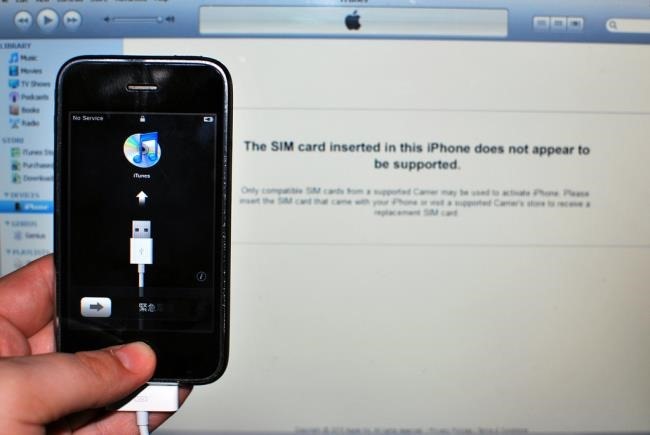
Many phones are sold locked to a specific network. When you buy a phone from a cellular carrier, they often lock that phone to their network so you can’t take it to a competitor’s network. That’s why you’ll often need to unlock a phone before you can move it to a different cellular provider or take it to a different country and use it on a local provider instead of roaming.Cellular carriers will generally unlock your phone for you as long as you’re no longer in a contract with them. However, unlocking a cell phone you’ve paid for without your carrier’s permission is currently a crime in the USA.
GSM vs. CDMA
Some cellular networks use the GSM (Global System for Mobile Communications) standard, while some use CDMA (Code-division multiple access). Worldwide, most cellular networks use GSM. In the USA, both GSM and CDMA are popular.Verizon, Sprint, and other carriers that use their networks use CDMA. AT&T, T-Mobile, and other carriers that use their networks are use GSM. These are two competing standards and are not interoperable. This means you can’t simply take a phone from Verizon to T-Mobile, or from AT&T to Sprint. These carriers have incompatible phones.

CDMA Restrictions
CDMA is more restricted than GSM. GSM phones have SIM cards. Simply open the phone, pop out the SIM card, and pop in a new SIM card to switch carriers. (In reality, it’s more complicated thanks to phone locking and other factors here.)CDMA phones don’t have removable modules like this. All CDMA phones ship locked to a specific network and you’d have to get both your old carrier and your new carrier to cooperate to switch phones between them. In reality, many people just consider CDMA phones eternally locked to a specific carrier.

Frequencies
Different cellular networks throughout the USA and the rest of the world use different frequencies. These radio frequencies have to be supported by your phone’s hardware or your phone simply can’t work on a network using those frequencies.Many GSM phones support three or four bands of frequencies — 900/1800/1900 MHz, 850/1800/1900 MHz, or 850/900/1800/1900 MHz. These are sometimes called “world phones” because they allow easier roaming. This allows the manufacturer to produce a phone that will support all GSM networks in the world and allows their customers to travel with those phones. If your phone doesn’t support the appropriate frequencies, it won’t work on certain networks.

LTE Bands
When it comes to newer, faster LTE networks, different frequencies are still a concern. LTE frequencies are generally known as “LTE bands.” To use a smartphone on a certain LTE network, that smartphone will have to support that LTE network’s frequency. Different models of phones are often created to work on different LTE networks around the world. However, phones are generally supporting more and more LTE networks and becoming more and more interoperable over time.
SIM Card Sizes
The SIM cards used in GSM phones come in different sizes. Newer phones use smaller SIM cards to save space and be more compact.This isn’t a big obstacle, as the different sizes of SIM cards — full-size SIM, mini-SIM, micro-SIM, and nano-SIM are actually compatible. The only difference between them is the size of the plastic card surrounding the SIM’s chip. The actual chip is the same size between all the SIM cards. This means you can take an old SIM card and cut the plastic off until it becomes a smaller-size SIM card that fits in a modern phone. Or, you can take a smaller-size SIM card and insert it into a tray so that it becomes a larger-size SIM card that fits in an older phone.
Be aware that it’s very possible to damage your SIM card and make it not work properly by cutting it to the wrong dimensions. Your cellular carrier will often be able to cut your SIM card for you or give you a new one if you want to use an old SIM card in a new phone. Hopefully they won’t overcharge you for this service, too.

Be sure to check what types of networks, frequencies, and LTE bands your phone supports before trying to move it between networks. You may have to buy a new phone when moving between certain cellular carriers.
Tuesday, May 27, 2014
Ask HTG: How Do I Change Window 8′s Hideous Purple Background Color?
Sometimes it’s the big changes in a new OS that really grind your gears and, other times, it’s something as simple as finding the background color to be an eyesore. Let’s take a look at how you can easily change the background/accent color in Windows 8.
Dear How-To Geek,First, we commend you on doing some old fashioned search engine leg work to get to the bottom of your problem. Second, rest easy knowing that even though you’re failing to find the setting you’re looking for, it’s not because it’s right in front of your face. The crux of your problem is that between Windows 8 and Windows 8.1, Microsoft moved the location of the menu you’re looking for (and to an obscure location at that).
It’s ridiculous, but I can’t tell you how much the default purple color in Windows 8 really bothers me. It’s so loud it hurts my face. I want something simple and mute in intensity, like a nice mild gray.
Now, before you assume I didn’t even attempt to remedy the problem on my own, I did! I’ve looked in every freaking menu I can find and it’s like the setting doesn’t even exist. I even searched with Google and found multiple articles, including one you guys wrote about changing the Windows 8 start screen and it’s like the setting that was there is now gone. I can’t find a single stupid box, check mark, radio button, or anything to even begin the process. What gives? Where did the freaking setting go?
I’m running Windows 8.1, no additional updates or custom interface tools/modifications. Help!
Sincerely,
Purple Hatin’
In Windows 8, you navigate to the menu you’re looking for via the Charms bar (WIN+C) then Change PC Settings -> Personalize -> Start Screen, and select the background accent combination you want from the slider interface at the bottom of the Start Screen customization panel. That’s the technique outlined in our article you referenced and most likely outlined in all the search results you were finding. Annoyingly, that menu got shifted around and practically buried during the Windows 8.1 update (we’d suspect that shift was/is part of Microsoft’s movement to distance Windows 8 from their very poorly received Modern UI). Now to change things you have to find the menu via the search function. You can jump to the search function by pressing WIN+C to pull up the Charms menu and then clicking on the search icon or, for even speedier access, you can simply press WIN+W to jump right to the search box:

In the search box, type “accent” to pull up the “Change the background and colors on Start” menu. Even if you use Windows 8.1 entirely in desktop mode, you still need to use this menu to change the color of the popup notifications (like the kind you get when inserting removable media) and the color of the lock screen. In this well-hidden sub-section of the Personalize menu, you can now independently mix and match the background color and accent color:
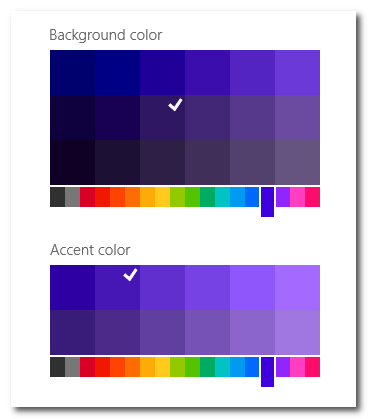
For reference, the background color will be the background color of your Modern interface, as well as the background color of primary Windows 8 Modern-related interfaces such as the background of any sub-menus in the Charms interface. The accent color will be the new color of the Windows 8 Start button, interface buttons, and highlighted options within interface menus. Change both to the shade of gray you’re looking for and your problem is solved.
Subscribe to:
Comments (Atom)